


Most design systems start with good intentions: make things consistent, reduce duplication, improve designer–developer handoff. But too often, they stall out at the surface level – a well-documented component library, some tokens, maybe a Figma plugin or two. It's useful, sure. But it's not strategic.
The real value isn't in faster button placement – it's in faster decisions, lower risk, and clearer alignment between what you build and what the business needs.
Your design system isn't just a design tool, it's an organisational lever. Or it could be, if you treat it like a product engine instead of an asset manager.
I've watched this pattern play out repeatedly. Promising systems get stuck in the "pretty component library" phase – all polish, minimal impact. The ones that break through? They stop thinking like a UI kit and start thinking like infrastructure.
A few years ago, I worked with a team that transformed their approach entirely, What began as a basic component library evolved into something much more strategic – they embedded accessibility requirements directly into component APIs, built triage workflows into their contribution process, and encoded compliance rules into their design tokens. The components looked similar, but they carried context, constraints, and institutional knowledge that shaped how the entire organisation built products.
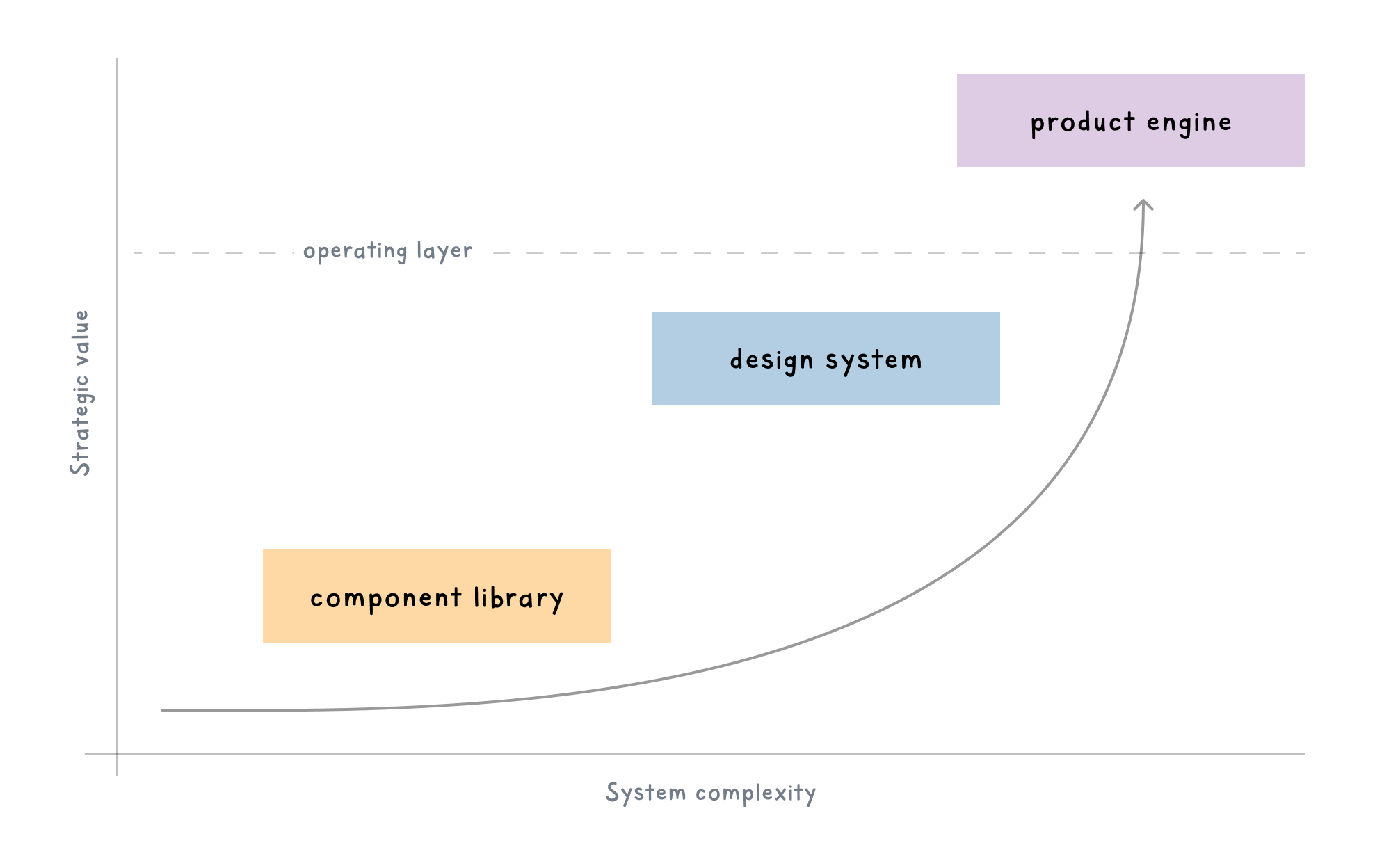
From visual kit to operating layer
When a system matures beyond a visual language, it starts to act like an operating layer across the organisation. The UI kit becomes infrastructure. The components encode constraints. Tokens become programmable levers – enforcing pricing tiers, eligibility rules, regulatory flags, and accessibility guarantees.
The most effective systems I've worked with don't just scale design – they scale intent. And they do it by embedding meaning where other teams would embed decoration.
- A modal isn't just a pattern – it includes defaults for priority, focus trap behaviour, and safe-dismiss logic
- A table isn't just rows and cells – it bakes in sorting, empty states, permissions logic, and performance thresholds
- A button isn't just a button – it carries analytics hooks, loading logic, and fallback behaviour when async calls fail.
When that context is encoded into the system, it stops being a design convenience. It becomes product strategy in motion.

Clarity scales faster than consistency
Standardisation gets a lot of attention in system conversations. It’s easy to count, easy to enforce, easy to celebrate. But clarity is what actually scales.
Teams need to know:
- What parts of the system are fixed, and why
- What parts are flexible, and how
- What to do when their product needs something the system doesn’t yet cover
If that isn't clear, teams will fragment. Not because they're ignoring the system, but because they're trying to move faster than it allows.
So the role of the system team shifts. You're not just building components; you're designing contracts. You're architecting for change. You're enabling autonomy without creating chaos.
And that requires real infrastructure: contribution models, versioning principles, role definitions, and support pathways that treat teams as customers, not obstacles.
Questions to ask your organisation:
- Where is our system helping teams ship faster, and where is it slowing them down?
- What decisions are currently repeated that the system could standardise?
- Who owns system evolution? Are they resourced to do it?
- What would break if we removed the system tomorrow?
- What part of our strategy could be encoded in the system itself?
Tools that can help clarify these boundaries include Backlight for component governance, Zeroheight or Storybook for centralising documentation, and Tokens Studio to visualise and manage token flexibility.

Structure your team like you structure your system
The structure of your system team – and how it interacts with product teams – directly shapes adoption, trust, and long-term impact.
If your system team is siloed, only shipping work through quarterly backlogs, you're a factory line.
If you're embedded, deeply involved in product planning and feature delivery, you're a service layer.
But the highest-leverage model I've seen is hybrid: a small core team maintaining critical infrastructure, supported by a network of embedded designers and engineers who co-own parts of the system. Governance is distributed. Ownership is shared. And the system grows in the directions the organisation is already moving.
This is how you avoid the "ivory tower" trap – where the system team builds elegant solutions to problems nobody's asking to solve.

Talk in metrics that matter
If your design system metrics still revolve around "number of components" or "percentage adoption," you're speaking the wrong language. Those are internal health metrics – necessary, but insufficient.
To resonate at the executive level, your system needs to demonstrate:
- Delivery acceleration: Are teams shipping faster because of the system?
- Risk reduction: Are accessibility violations, QA bugs, or design–dev mismatches decreasing over time?
- Reuse and return: How many net-new features are using existing patterns versus creating new ones?
- Strategic alignment: Can the system encode and propagate initiatives like AI-readiness or compliance at scale?
And if you're not tracking these yet, your system might be running – but it's not driving.
Early signals your system is becoming a product engine:
- Feature teams ask for patterns, not components
- You're consulted during roadmap planning, not just implementation
- Product teams are contributing back with confidence
- System metrics correlate with business outcomes (faster time-to-ship, fewer defects)
- The system encodes regulatory, legal, or strategic constraints

Your system is an API – design it like one
Design systems are already consumed like APIs – by developers, designers, AI tools, and increasingly, by autonomous agents.
Which means your system already has interfaces. The question is whether those interfaces are clear, consistent, and durable.
A well-structured system should behave like a good API:
- Explicit contracts: Semantic props, not just visual ones
- Composable structures: Clear nesting and slot logic
- Predictable naming: No surprises, meaningful defaults
- Machine readability: Tokens and metadata exposed in toolable formats
Because increasingly, the interface you're designing isn't visual. It’s structural. And if your system can't be parsed by tools, it's not going to scale with them.
Tools like Style Dictionary and Knapsack help structure and expose interfaces with machine-readable consistency. Storybook enables stateful documentation and previews that feel native to engineers.

System thinking is strategy thinking
If you want to influence strategy, don’t wait to be invited to the table. Build the systems that make strategy executable.
- Want to improve accessibility? Encode it in components and linting rules.
- Want better experimentation? Create variants with built-in instrumentation.
- Want to support global scale? Bake locale-awareness into layout, copy, and form design.
Every business objective eventually touches product. Every product surface eventually touches the system.
Design your system with that lens – not just for today's components, but for tomorrow’s workflows – and you move from asset manager to infrastructure owner.
And that's where the leverage really begins.
Thanks for reading! This article is also available on Medium, where I share more posts like this. If you're active there, feel free to follow me for updates.
I'd love to stay connected – join the conversation on X, Bluesky, or connect with me on LinkedIn to talk design, digital products, and everything in between.


Member discussion